
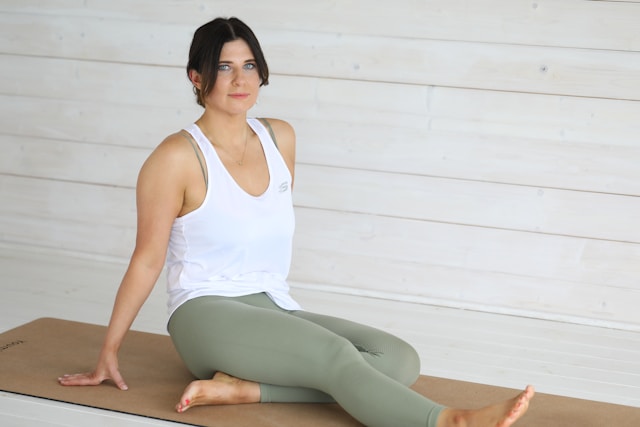
Leela Fernandez does not teach yoga as an escape from the body. She teaches it as a way back in.
Long before she ever stood at the front of a studio, guiding others through breath and movement, Leela lived largely disconnected from her physical self. Raised in an environment marked by emotional unpredictability and unspoken fear, her nervous system learned vigilance early. “I didn’t have language for trauma back then,” she says. “I just knew I was always bracing for something.”
That constant state of alertness followed her into adulthood. Despite appearing functional — successful even — Leela struggled with anxiety, dissociation, and an inability to rest deeply. Traditional wellness advice only intensified her distress. “I kept hearing messages about pushing through discomfort,” she explains. “But my body had been uncomfortable my entire life.”
Her first yoga class, taken almost accidentally, was not transformative in the way popular narratives suggest. It was confusing, even confronting. Being asked to notice sensations felt overwhelming. Yet something subtle shifted. “For the first time, I realized my body wasn’t the enemy,” she recalls. “It was trying to protect me.”
Rather than immersing herself immediately in teacher trainings, Leela began studying trauma psychology, neurobiology, and somatic therapy alongside yoga philosophy. She learned that trauma lives not only in memory, but in muscle tone, breath patterns, and posture. Healing, therefore, required safety before flexibility, choice before instruction.
This understanding became the foundation of Rooted Stillness Studio, a space intentionally designed to counter the performance-driven culture of modern wellness. Classes are small, language is invitational, and stillness is valued as much as movement. Students are never adjusted without consent. Options are offered continuously.
“Agency is medicine,” Leela says simply.
Her clients include survivors of abuse, individuals living with PTSD, chronic anxiety sufferers, and people who have long felt alienated from their bodies. Many arrive skeptical. “They’re used to being told what to do,” she explains. “I invite them to listen instead.”
Leela’s sessions focus on grounding, orientation, and breath awareness — practices that help regulate the nervous system rather than overstimulate it. She avoids dramatic poses and instead emphasizes sensations of support: the floor beneath the feet, the steadiness of breath, the choice to pause.
The impact, she notes, is often quiet but profound. “Someone staying present for thirty seconds longer than before — that’s healing.”
Her own relationship with wellness continues to evolve. Leela is careful not to romanticize recovery. “Trauma healing isn’t linear,” she says. “There are seasons of growth and seasons of rest.” She structures her life accordingly, maintaining strong boundaries around work, rest, and creative solitude.
Beyond the studio, Leela collaborates with therapists, social workers, and healthcare providers to integrate movement-based healing into mental health care. She also trains other yoga teachers to adopt trauma-informed frameworks, challenging an industry that often prioritizes aesthetics over safety.
“One-size-fits-all wellness can be harmful,” she warns. “Especially for nervous systems that have learned to survive.”
For Leela Fernandez, wellbeing is not about transcendence. It is about presence. Not about achievement, but about attunement. Her work offers a countercultural message in a world obsessed with optimization: healing begins when the body feels safe enough to soften.
“Wellness,” she reflects, “is not becoming more. It’s needing less from yourself.”